|
When running gradient analysis, many people carefully
check column and mobile phase conditions, but surprisingly few pay
attention to the mixer volume of their instrument. However, when
performing fast gradient analysis with short or narrow-bore columns,
the mixer volume can have a major impact on the chromatogram.
■ What happens when the mixer volume changes?
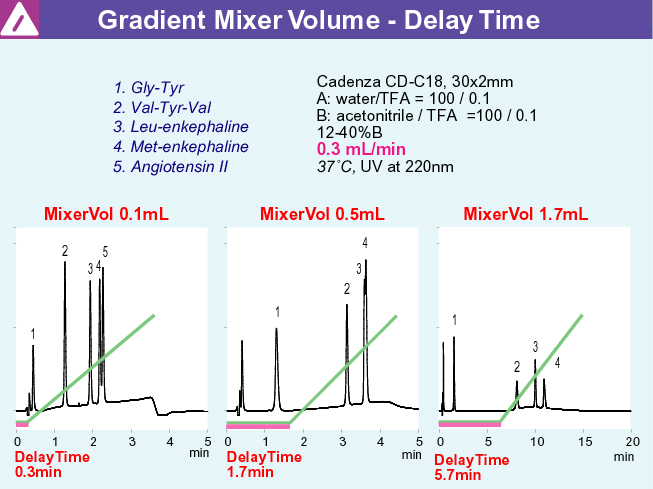
The figure above shows five peptides analyzed under identical
conditions, with only the mixer volume changed to 0.1 mL, 0.5 mL,
and 1.7 mL.
As the mixer volume increases, the analysis time
becomes longer, peak heights decrease, and even the separation
pattern changes.
■ The cause: "delay time"
Even when
the pump starts the gradient, the mixed mobile phase does not reach
the column immediately. It takes time to pass through the mixer
volume (the delay volume, or dwell volume), and this time is called
the delay time.
Delay time = Delay volume / Flow rate
In the example above, the delay time is 0.1 mL ÷ 0.3
mL/min = 0.3 min, and 1.7 mL ÷ 0.3 mL/min = 5.7 min.
Because a volume of initial-composition mobile phase
(12%B) equal to the mixer's internal volume (delay volume) continues
to flow isocratically through the column, the sample undergoes
unintended isocratic elution. Strongly retained components diffuse
within the column during this time, resulting in broader peaks. On
the other hand, weakly retained components elute before the gradient
arrives, so they are hardly affected by the mixer volume. Because
each component is affected differently, peak spacing and even the
separation pattern change.
The shorter and narrower the column, the relatively
greater the effect of the mixer volume. Even an instrument that
caused no problems with a long 4.6 mm ID column may fail to
reproduce results once you switch to a short 2 mm ID column.
■ Know your instrument's delay volume
The same method can give different results on different instruments.
In method transfer or when comparing data with other laboratories,
differences in delay volume between instruments are often the cause
of discrepancies.
■ Choose a mixer suited to your column size
For fast analysis with short, narrow-bore columns, a small-volume
mixer is advantageous.
■ Smaller is not always better
Reducing the mixer volume can lead to insufficient mixing, making
baseline waviness and noise more likely. This is especially
noticeable when detecting mobile phases containing TFA at low
wavelengths (e.g., 220 nm), in which case a larger mixer volume is
needed.
■ Differences between gradient systems
Low-pressure gradient systems mix the mobile phases with a single
pump, so they require a large-volume mixer. High-pressure gradient
systems, on the other hand, mix the mobile phases by controlling the
delivery rates of two pumps, so mixing can be achieved with a small
mixer.
(Reference)
Differences in gradient system configuration
■ Summary
The reproducibility of
gradient analysis depends not only on the column and mobile phase
but also on the mixer volume of the instrument. It is important to
know the mixer volume of the instrument you are using.
|