|
Do you believe that
semi-micro columns provide higher theoretical plate numbers
or that narrower columns
always deliver better separation performance?
In fact, this is one of the most
common misconceptions in HPLC.
When a sample enters a
narrow-bore column, the diffusion distance across the column radius
is shorter than in a larger column. Therefore, it is often assumed
that a smaller internal diameter reduces radial diffusion, resulting
in sharper peaks.
However, this explanation
overlooks one very important fact.
HPLC Uses "Surface Injection," Not "Point Injection"
At the inlet of every HPLC column is a
distributor, whose
role is to spread the incoming sample uniformly across the entire
cross-section of the column.
Structure of
an HPLC Column
Although the sample exits the connecting tubing as a narrow stream,
it is immediately distributed over the entire column cross-section
before entering the packed bed. In other words, the sample changes
from a "point" into a "band" at the column inlet. As it travels
through the packed bed, the band broadens through repeated diffusion
in both the axial and radial directions, as well as diffusion
between the mobile phase and the stationary-phase surface.
Therefore, simply reducing the
column internal diameter does
not increase the
theoretical plate number.
What Actually Affects Theoretical
Plate Number?
In practical HPLC,
extra-column band broadening is often more significant than
diffusion inside the column itself.
Major contributors include:
-
Injector sample loop diameter and volume
-
Internal diameter and length of the tubing before the column
-
Internal diameter and length of the tubing after the column
-
Detector flow-cell volume
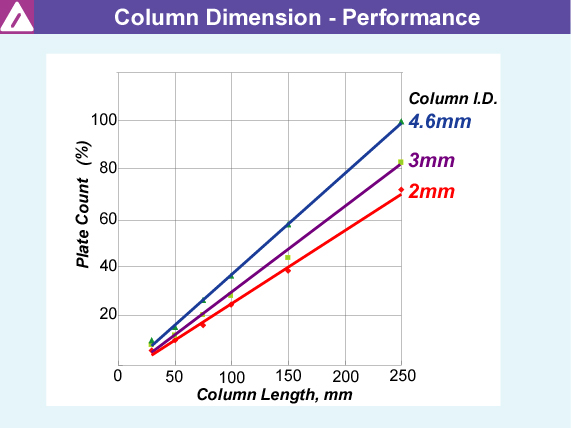
Because a 2 mm I.D. column
operates at a much lower flow rate, extra-column dispersion becomes
relatively more significant. Consequently, when the same HPLC
instrument is used,
narrower columns may actually exhibit lower theoretical plate
numbers.
For a properly packed column,
the theoretical plate number is determined primarily by
column length,
not by column internal diameter. Simply reducing the column diameter
does not improve column efficiency.
The Real Advantage of Semi-Micro
Columns
The greatest advantages of semi-micro columns are:
-
Reduced solvent consumption
-
Reduced waste solvent generation
-
Lower operating costs
Their primary benefit is
solvent savings,
not improved
separation efficiency.
Why a 3 mm I.D. Column Is a Good
Compromise
As shown in the figure above, reducing the column diameter directly
from 4.6 mm to 2 mm
significantly increases the relative influence of extra-column
dispersion, resulting in a noticeable decrease in theoretical plate
number.
A
3 mm I.D. column
provides a much better balance between performance and solvent
savings.
Its advantages include:
-
Approximately 50% lower solvent consumption than a 4.6 mm I.D.
column
-
Less susceptible to extra-column dispersion than a 2 mm I.D.
column
-
Easier to use with conventional semi-micro LC systems
-
Better balance between separation performance and solvent
economy
Summary
A narrower column does not
produce sharper peaks simply because its internal diameter is
smaller.
Since the distributor spreads
the sample uniformly across the column cross-section before it
enters the packed bed, the theoretical plate number is
not determined by column
diameter.
On conventional HPLC systems,
reducing the column diameter actually increases the relative effect
of extra-column dispersion, making it easier for the theoretical
plate number to decrease.
The greatest benefit of
semi-micro columns is
solvent reduction rather than higher efficiency.
Considering both
chromatographic performance and practical usability,
a 3 mm I.D. column
represents one of the most reasonable choices for routine HPLC
analysis.
|