|
It is often said that semi-micro columns provide higher
sensitivity. In many cases, however, this is a misconception arising
from differences in experimental conditions.
Experiments cited as evidence for improved sensitivity typically
use the same injection volume for both a 4.6 mm I.D. column and a
2.0 mm I.D. column. However, the flow rate should be adjusted in
proportion to the column cross-sectional area. For example, when the
flow rate for a 4.6 mm I.D. column is 1.0 mL/min, the corresponding
flow rate for a 2.0 mm I.D. column is approximately 0.2 mL/min.
Reducing the flow rate to one-fifth while keeping the injection
volume unchanged is not a fair comparison. In preparative
chromatography, it is well understood that the appropriate injection
volume is approximately proportional to the column cross-sectional
area.
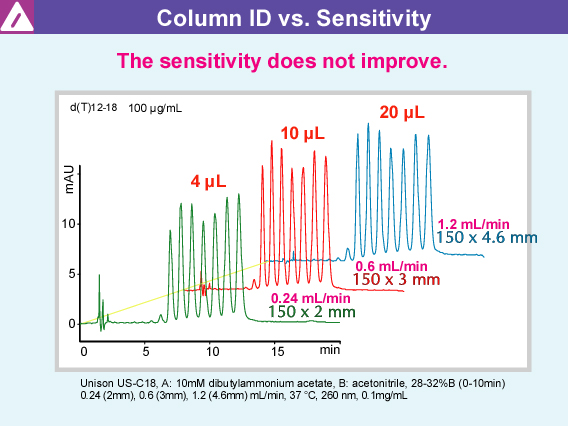
Injection Volume Should Also Be
Proportional to Column Area
The cross-sectional area of a 2.0 mm
I.D. column is approximately one-fifth that of a 4.6 mm I.D. column.
Therefore, if the flow rate is reduced to one-fifth, the injection
volume should also be reduced to one-fifth in order to maintain the
same sample load.
When columns are compared under these conditions, retention
times and peak heights become nearly identical, as shown in the
figure.
Concentration Sensitivity Does Not
Depend on Column I.D.
When the sample concentration is the
same and the injection volume is proportional to the column
cross-sectional area, peak height is determined primarily by sample
concentration and is largely independent of column diameter. This is
referred to as concentration sensitivity.
Therefore, from a theoretical standpoint, simply changing
from a conventional analytical column to a semi-micro column does
not improve concentration sensitivity.
When Smaller Columns Can Increase
Sensitivity
The situation is different when the
injection volume is limited.
If the same injection volume is
applied to columns of different diameters, a smaller column receives
a greater amount of analyte per unit cross-sectional area, resulting
in higher peak heights. This represents an improvement in
mass sensitivity.
This is one reason why micro-LC and
nano-LC are widely used for highly sensitive analyses.
However, avoiding column overload is an absolute
requirement. For this reason, gradient elution, which provides a
strong sample-focusing effect, is commonly used with small-diameter
columns.
Advantages of Semi-Micro Columns
The primary advantages of semi-micro
columns are not increased sensitivity, but rather reduced solvent
consumption and improved compatibility with mass spectrometry (MS).
For example, a method operated at 1.0
mL/min on a 4.6 mm I.D. column corresponds to approximately 0.2
mL/min on a 2.0 mm I.D. column. Thus, equivalent separations can be
achieved while reducing mobile-phase consumption by approximately
80%, significantly lowering operating costs and solvent waste.
It should be noted, however, that
extra-column band broadening becomes more significant as column
diameter decreases. As a result, column efficiency tends to
deteriorate more readily with very small I.D. columns. For many
applications, a 3.0 mm I.D. column provides an excellent compromise
between solvent savings and chromatographic performance.
In LC-MS applications, lower flow
rates also place less demand on the ionization source and are
generally more compatible with MS operation. Semi-micro columns with
2.0 mm or 3.0 mm internal diameters operate within a flow-rate range
that is often ideal for MS detection, enabling more efficient mass
spectrometric analysis.
For this reason, semi-micro columns have become widely used
in modern LC-MS workflows.
Conclusion
The value of semi-micro columns lies
not in higher sensitivity, but in their ability to reduce solvent
consumption and provide flow-rate conditions that are well suited
for MS detection.
In other words:
Semi-micro columns are not inherently more
sensitive; they are more solvent-efficient and more MS-friendly.
|