|
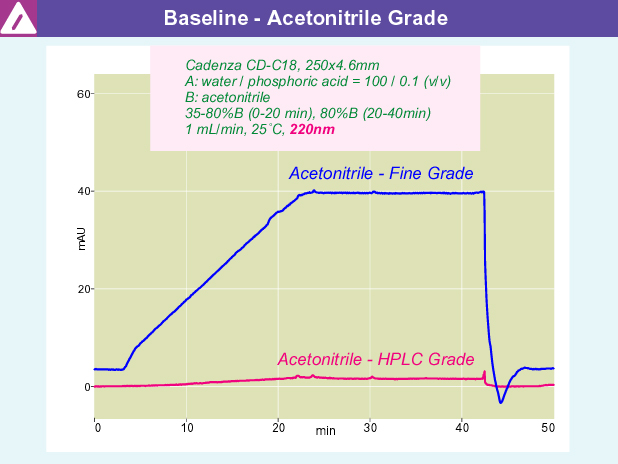
When the detector wavelength is
set to a short wavelength such as 220nm, the absorbance of the
mobile phase itself has a significant effect on the baseline.
This effect is particularly evident with organic solvents like
acetonitrile, where the difference between reagent grade (Fine
Grade) and HPLC grade is clearly reflected in the baseline behavior.
The figure above compares the
baselines obtained at 220nm using a Cadenza CD-C18 column (250 × 4.6
mm).
Mobile phase A was water
containing phosphoric acid diluted 1/1000 (v/v).
Mobile phase B was acetonitrile of different purities.
A gradient from 35%B to 80%B was applied.
With Fine Grade acetonitrile,
the baseline rises steeply as the gradient progresses.
In contrast, with HPLC Grade acetonitrile, almost no baseline
fluctuation is observed.
This difference arises from the
presence or absence of trace impurities in the acetonitrile —
particularly UV-absorbing organic compounds such as
acrylonitrile and
acrolein.
In general reagent-grade solvents, purification is not sufficient to
remove these species, and their absorption in the short-wavelength
UV region becomes significant, causing the baseline to increase
during the gradient.
HPLC Grade
acetonitrile, on the other hand, is highly purified to remove
UV-absorbing substances, resulting in a nearly flat baseline even
under gradient conditions.
In short-wavelength detection
(200–230 nm), the purity of the mobile-phase solvent greatly affects
the chromatographic result.
Using HPLC Grade
acetonitrile is essential to prevent unnecessary baseline
drift and to maintain quantitative accuracy for trace components.
|