|
Highly polar ionic compounds are difficult to retain on
reversed-phase columns, such as ODS, which rely on hydrophobic
interactions. In such cases, ion-exchange chromatography, which
utilizes the ionic character of the analytes, is effective.
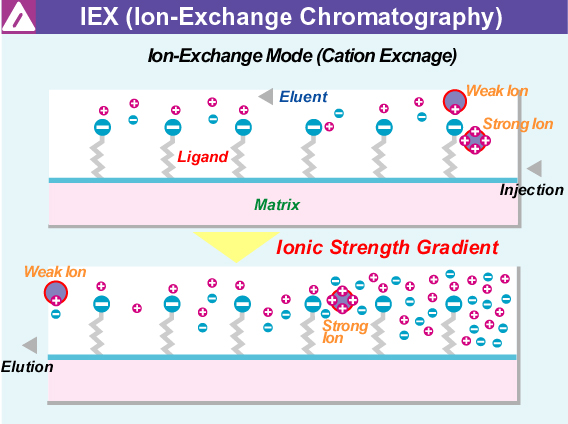
Ion-exchange chromatography separates compounds by exploiting the
strong interaction known as an
ionic bond, a type
of chemical interaction. As illustrated above, for cationic
analytes, the analyte is first completely adsorbed ionically onto an
anion-exchange stationary phase. At this stage, a low ionic strength
aqueous solution is used as the mobile phase to allow adsorption of
the analyte onto the stationary phase. A (+)/(–) ionic interaction
exists between the analyte and the stationary phase.
To disrupt the ionic interactions between the analyte and the
stationary phase, a gradient
elution is applied by increasing the salt concentration
(ionic strength) in the mobile phase. Ions in the mobile phase
compete with the analyte and stationary phase for ionic
interactions, resulting in desorption of the analyte. Since the
elution behavior depends on the strength of the ionic interactions
of the analytes, weaker ions generally elute earlier than stronger
ions, enabling separation.
The ionic ligands used in ion-exchange chromatography engage in
strong ionic interactions with the analytes. Therefore,
isocratic elution,
which relies on weaker interactions such as hydrophobicity, is
extremely difficult. Gradient elution is essential to allow the
transition between "adsorbed" and "desorbed" states. Under isocratic
conditions, even small changes in the ion concentration in the
mobile phase can significantly affect retention, making
reproducibility difficult.
Gradient elution is typically achieved by increasing the ionic
strength of the mobile phase, but pH adjustments can also be used to
modify the dissociation state of either the stationary phase or the
analyte. This approach is particularly effective when ionic
interactions are too strong to be disrupted solely by changing the
ionic strength.
IMTAKT offers the following ion-exchange columns for
small-molecule compounds. To enhance separation selectivity,
normal-phase mode
is often used in combination with ion-exchange mode:
Nardis
ND-NX
Unison
UK-Amino
Unison
UK-Silica
In addition, columns combining ion-exchange mode with
reversed-phase mode include:
Nardis
ND-RX
Scherzo
SS-C18, SM-C18, SW-C18
|