|
Many of the compounds targeted for
HPLC analysis tend to exist as ions (cations or anions). When
analyzing such ionic compounds (solutes) by HPLC, retention can vary
significantly depending on whether the solute is in its dissociated
or non-dissociated form.
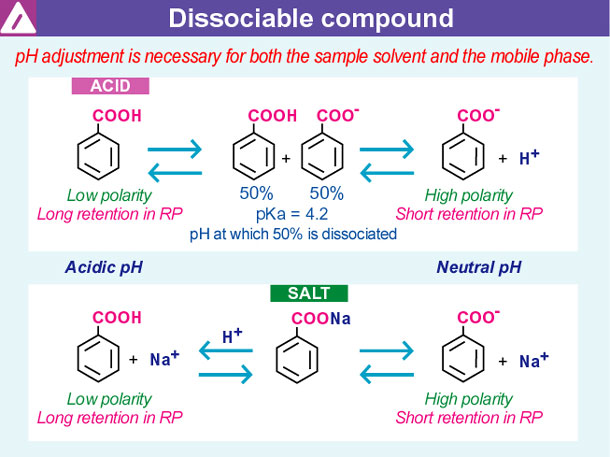
As shown in the figure above, the
dissociation state of ionic compounds varies depending on the pH of
the sample solvent and mobile phase.
In the case of benzoic acid,
under acidic conditions, the carboxyl group remains non-dissociated,
increasing the compound's hydrophobicity and resulting in longer
retention in reversed-phase chromatography. On the other hand, at
neutral pH, the carboxyl group dissociates to form an anion, making
the compound more polar and reducing its retention in reversed-phase
mode.
Thus, when analyzing ionic compounds, their dissociation state (and
consequently their hydrophobicity) changes with the mobile phase pH,
which in turn affects retention. To achieve optimal retention,
separation, and peak shape, adjusting the pH and ionic strength of
the mobile phase is essential.
Another important factor when
selecting the mobile phase pH for analyzing ionic compounds is the
pKa of the solute.
Ionic compounds have characteristic pKa values, and when the mobile
phase pH is set equal to the pKa, the solute exists in a 50/50
mixture of dissociated and non-dissociated forms.
Since the solute simultaneously exhibits two different hydrophobic
states (dissociated and non-dissociated), this can result in broad
peaks or even peak splitting. Therefore, when analyzing ionic
compounds, it is important
not to set the mobile phase pH near the solute’s pKa.
Some people say they want to
"analyze a salt." However, in reversed-phase systems using water,
salts dissociate into cations and anions, so it is not possible to
analyze them as intact salts. In such cases as well, the
hydrophobicity of the components changes depending on the pH, making
it essential to adjust both the pH and ionic strength of the mobile
phase.
To adjust the pH and ionic strength
of the mobile phase, the following volatile additives are convenient
and can be used either alone or in combination:
Since these additives are volatile,
they do not precipitate inside the column. They are miscible with
over 90% organic solvent, and even if immiscible, they tend to form
micelles rather than cause damage to the column—an important
advantage.
A further major benefit, unlike inorganic salts, is that ammonium
acetate and ammonium formate are highly volatile even at
concentrations as high as 100 mM. This greatly reduces the risk of
contamination inside the vacuum region of an MS system.
In contrast, conventional phosphate
buffers have high ionic strength but poor compatibility with organic
solvents. When the organic solvent content exceeds 50%, salt
precipitation can occur. If this precipitation happens inside the
column, it can lead to a sudden increase in column pressure.
Moreover, this precipitate cannot be removed by simply washing with
water, meaning the pressure cannot be reduced.
Of course,
phosphate buffers are also unsuitable for MS detection.
With the rapid adoption of LC-MS,
the use of traditional phosphate buffers in mobile phase
compositions is no longer recommended, as they can cause significant
damage to the column.
For pH adjustment in HPLC mobile phases, it is strongly recommended
to use acetic acid/ammonium acetate or formic acid/ammonium formate
buffer systems.
(Reference)
Do not use
a pH meter for mobile phase pH adjustment.
<Volatile buffers such as acetic
acid/ammonium acetate and formic acid/ammonium formate systems.>
|